The 8 biggest mistakes when buying children's scooters (and how parents can avoid them)
Prices for scooters range from 50 to well over 300 Swiss francs, and what really makes a good scooter is rarely indicated on the packaging. Many parents base their choice on price, choose based on appearance, or buy the same model as their neighbour’s child, without knowing whether it’s suitable for their own child.
Here are the 8 most common mistakes, what they actually mean and how to avoid them.
Mistake 1: Buying the wrong type of scooter for the child’s age
Two wheels or three?
Tricycles are self-stabilising. For children up to around 4–5 years old, who are still learning to balance, this is a real advantage. Bicycles require active balancing on the central axis, a skill that usually only develops from around 4–5 years of age, earlier for some, later for others.
The age stated on the packaging is a guide, not the deciding factor. What matters is the child’s stage of development: can the child stand securely on one leg? Do they react quickly to uneven ground? Do they have the confidence to balance for short distances without holding on? If not, a tricycle is the right choice, even if, based on the age recommendation, the child ‘should’ already be riding a two-wheeler.
If the person isn't right for the job: specific risks
A 4-year-old simply cannot control a stunt scooter. Stunt scooters have fixed handlebars with no height adjustment and are designed for stability when performing tricks, not for the motor skills of young children. The result: falls, frustration, and a scooter that ends up in the basement.
Conversely, an 8-year-old on a toddler tricycle scooter is underchallenged, rides in an unnaturally hunched position and loses interest within a few days. A scooter that is too small is just as unsuitable as one that is too big.
Mistake 2: Confusing stunt scooters and kickboards
Why stunt scooters aren't foldable
The hinge on a folding scooter is, by design, a weak point. In everyday use, such as a leisurely ride to school, this isn’t a problem. But on a ramp or when performing tricks, the frame is subjected to entirely different forces. A folding mechanism under this kind of strain can fail, and when it does, it usually fails suddenly.
Stunt scooters therefore have a rigid, one-piece construction: no folding axle, no joint, no moving parts in the frame. Anyone who takes a kick scooter onto ramps and obstacles risks exactly that.
Who needs what?
Kickboards are designed for the journey to school, trips to the park and everyday use. They fold up, fit in a car or on public transport, and are often lighter. Stunt scooters are sports equipment: for skateparks, ramps and more experienced children aged around 6–8 who want to learn specific tricks.
If you want both, you’ll need two boards. There’s no good compromise between a folding mechanism and stability when jumping.
Mistake 3: Buying a cheap scooter without realising what can go wrong
What exactly can happen with no-name scooters from the Far East
Cheap plastic, low-quality paints, uninspected handle materials: when it comes to children’s products, this is no minor issue. The REACH Regulation sets clear limits for harmful substances in products intended for children: lead in paints and varnishes, phthalates (plasticisers) in plastic handles, and polycyclic aromatic hydrocarbons (PAHs) in rubber parts.
No-name manufacturers without quality control can ignore these limits. Equally problematic are brakes that are not designed to meet standards and frame parts that are designed as predetermined breaking points.
Understanding security certificates
What to look for when buying:
· EN 71: EU safety standard for toys, applicable to scooters for riders weighing up to 50 kg.
· EN 14619: Standard for sports scooters and roller sports equipment, relevant for stunt scooters and sports models.
Brand vs. No-Name
The price difference between a CHF 50 scooter and a branded model costing CHF 250 comes down to three factors: quality control during production, the availability of spare parts, and liability. Branded manufacturers stand behind their products with their reputation. No-name products often disappear from the market quickly, and with them any point of contact for complaints or spare parts.
Mistake 4: Underestimating technical details that directly affect safety and driving pleasure
Wheel diameter: more than just a minor detail
Small wheels (under 100 mm) struggle with every small stone, every pavement joint and every bump. From 120 mm upwards, riding on normal surfaces becomes significantly more stable and comfortable. For everyday riding on tarmac, wheels measuring 100–120 mm are the sensible minimum standard. The larger the wheel, the faster the scooter goes.
ABEC 5 vs. ABEC 7: What the difference means in everyday use
ABEC is a standard for ball bearing precision. The higher the number, the tighter the manufacturing tolerance and the smoother the bearing runs. For leisure equipment, the ABEC rating is less crucial than the quality of the seal against dirt and moisture. Nevertheless, ABEC 5 is a solid minimum standard, whilst ABEC 7 runs noticeably smoother and lasts longer. Chilli Pro Scooter has opted for ABEC 9 ball bearings to ensure the right quality standard.
Pneumatic tyres or solid tyres?
Pneumatic tyres absorb bumps and provide better grip on loose or wet surfaces. The downside is that they can go flat and need to be pumped up from time to time. Solid tyres are maintenance-free, but ride comfort is significantly reduced on poor surfaces. For city kids on paved or tarmac surfaces, solid tyres are usually sufficient. For younger children and uneven surfaces, the extra cost of pneumatic tyres is worth it.
Brake and tread
The standard foot brake (rear pedal brake) is easy for children aged around 5–6 and above to use, provided it is within easy reach and does not require excessive effort. Pedal surface too high: child cannot reach it. Pedal surface too small: unstable footing. If possible, let them try it out briefly. Griptape coating is more durable than a printed pattern, especially after a few rides in the rain.
Mistake 5: Ignoring ergonomics and physical limits
Height-adjustable handlebars
A scooter that’s just the right size in the spring may be too short by autumn. Height-adjustable handlebars significantly extend the scooter’s lifespan and prevent the child from riding in a hunched position all the time. This feature is often missing altogether on cheaper models.
Scooter weight: striking the right balance
A scooter that is too heavy is too much for younger children to handle, carry and brake. A scooter that is too light is unstable and sensitive to uneven surfaces. As a guide: 3–5 kg depending on the age group. Under 3 kg for toddlers, up to 5 kg for older children.
maximum load
Every scooter has a specified maximum load. If a child exceeds this limit, there is a risk of frame failure, axle breakage or loss of braking power. This information can be found in the product data sheet or on the packaging and should be carefully checked at the time of purchase.
Mistake 6: Buying second-hand scooters without checking them
Why buying second-hand items on eBay and similar sites can be risky
The price is right, and the scooter looks good. What parents often don’t realise is that wear and tear on safety-critical parts is frequently invisible or goes unreported. Cracks in the deck, worn-out bearings and damaged folding joints can easily be overlooked without a thorough inspection.
Safety check before buying second-hand
Before taking delivery of a second-hand scooter, check the following points:
· Deck and welds: Check for hairline cracks, warping or bulges, particularly at the connection between the handlebar tube and the footboard
· Screws and axles: Check all fixed connections for play and looseness
· Handlebar clamp: Does the handlebar give way when pressure is applied from the side? If so, do not buy it.
· Brake: Is the rear foot brake still present and working? Does it spring back?
· Wheels and bearings: Do the wheels turn freely and quietly? No side-to-side play?
· Handles: Torn, frayed, no longer secure?
· Folding joint (if present): No play, no wobble, locks securely into place?
When a second-hand scooter is no longer safe
Cracks or warping in the footboard are deal-breakers. The same goes for a rattling or loose folding hinge. Wheels and brakes can be replaced, but the frame cannot. If the frame is damaged, it’s better to buy a new one.
Mistake 7: Treating protective equipment as optional
A helmet is not an option
Head injuries are the most common type of serious injury sustained in scooter accidents. The BFU (Swiss Council for Accident Prevention) recommends wearing a helmet, knee pads, elbow pads and wrist guards for all scooter activities. The fact that there is no legal requirement to wear a helmet in Switzerland does not mean that a fall without a helmet is harmless. According to the BFU, around 51 people in Switzerland suffer serious injuries each year whilst riding scooters, skateboards and inline skates, the majority of whom are under 15 years of age.
This applies doubly to stunt scooter riders and children who are just learning to ride. Standard-compliant children’s helmets (EN 1078) provide reliable protection, provided the helmet fits correctly: two fingers’ width above the eyebrows, with the chin strap fastened securely.
Knee and elbow pads
When riding a stunt scooter and learning the basics, it’s worth wearing knee and elbow pads. Children learn by trial and error, and trial and error means falls. Pads absorb the initial impact and give children the confidence to try again.
Secure the scooter
Many scooter models do not have a frame loop or recesses. If you want to lock your scooter up regularly outside school, at the playground or when out shopping, you should check this when buying.
Mistake 8: Not taking durability and maintenance into account
‘Worn out after just one season’
Cheap scooters are often designed in such a way that spare parts are unavailable and repairs aren’t worth the effort: short product lifecycles, no stock, no after-sales service. In many cases, buying a no-name scooter means buying a disposable product.
It’s different with brand-name manufacturers. At Chilli Pro Scooter, we offer spare parts and build scooters that can be repaired: wheels, bearings, handles and brakes can all be replaced. A scooter that gets new wheels or new handles after two years is not a disposable product.
Basic maintenance
Even good scooters need looking after. A quick check every few weeks is enough:
● Tighten the screws: On stunt scooters in particular, screws can come loose more quickly than you might think due to vibration and stress, so give them a quick check after every intensive session
● Clean the bearings: Sand and water can damage the bearings. Clean them occasionally and replace them after one or two seasons
● Check the brake: Is the brake still working properly? Does it spring back? Does it lie flat against the wheel?
Where are e-scooters actually allowed to be ridden?
In Switzerland, scooters and kick scooters are classified as vehicle-like devices. They may be ridden on pavements and footpaths. Cycle paths may be used provided there is a sign indicating that this is permitted. Roadways and main roads are off-limits. Children must always ride on areas that are also open to pedestrians and remain within sight of their parents.
Which scooter is right for which child?
For children up to around 5 years old: Micro as an entry-level model
Micro is the direct predecessor and parent brand of Chilli Pro Scooter. For the very youngest riders, Micro offers three-wheeled entry-level models, some of which feature optional LED lights. These meet the same quality and safety standards as Chilli, but are tailored to the motor skills of 2- to 5-year-olds.
For more experienced children aged around 6–8: Chilli Pro Scooter
We were integrated into the Micro Group as an independent brand in 2019. This shared commitment to quality means that Micro’s material standards, certifications and years of experience are directly incorporated into our product range. Stunt scooters built to withstand heavy use, for skateparks, ramps and riders who are serious about learning tricks.
Our range covers various skill levels: from sturdy beginner stunt scooters for children just starting out to high-end models for advanced riders.
Key buying criteria at a glance
● The child’s age and stage of development (balance, motor skills)
● Scooter type: stunt vs. kickboard, 2 vs. 3 wheels
● Safety certifications: EN 71 or EN 14619
● Wheel diameter (from 100–120 mm for everyday use)
● Ball bearing quality (minimum ABEC 5, sealed against dirt)
● Is the handlebar height-adjustable?
● Maximum load tested?
● Spare parts available from the manufacturer?
A scooter that suits the child will be ridden. Every day, intensively, with enthusiasm. One that doesn’t fit or breaks after a season ends up in the basement. With the right criteria, the decision is much easier to make, and you won’t have to buy another one.
-
- New
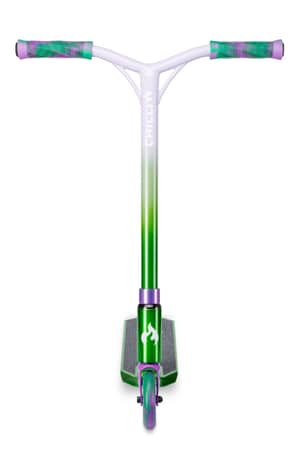
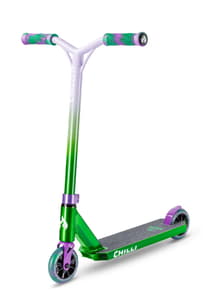
Chilli Pro Scooter Jumpstart - M - Green/Purple Eye-catching design in bright complementary colors- Jumpstart your freestyle journey in bright colors
- Boxed Profile Deck with the perfect width in 11.5 or 12.5 cm
- 110 mm Wheels with ABEC 9 Bearings for extra Speed
CHF 179.90 -

- New
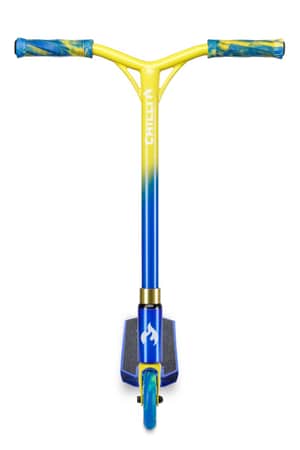
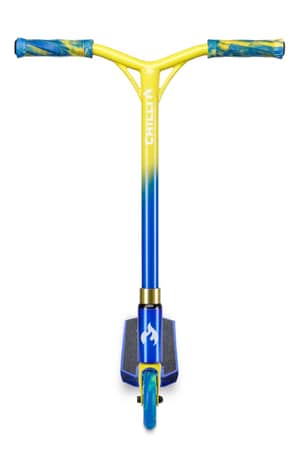
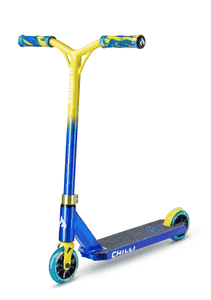
Chilli Pro Scooter Jumpstart - M - Blue/Yellow Eye-catching design in bright complementary colors- Jumpstart your freestyle journey in bright colors
- Boxed Profile Deck with the perfect width in 11.5 or 12.5 cm
- 110 mm Wheels with ABEC 9 Bearings for extra Speed
CHF 179.90 -
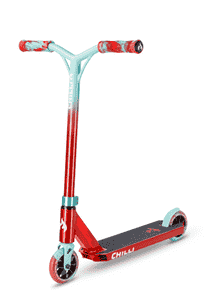
- New
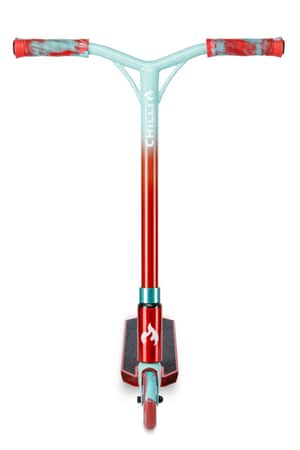
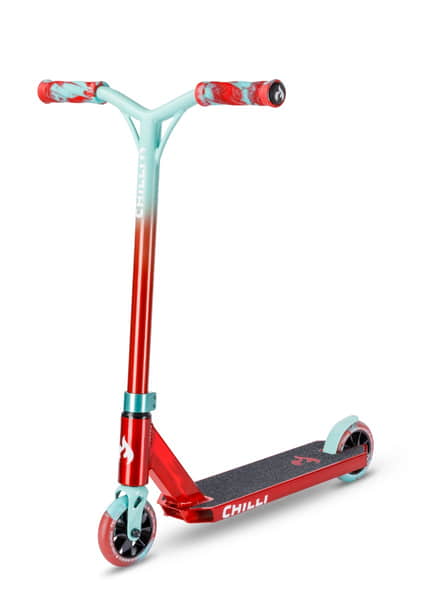
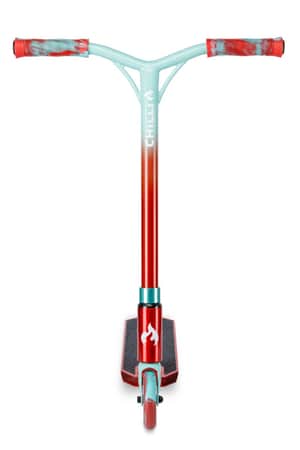
Chilli Pro Scooter Jumpstart M - Red/Teal Eye-catching design in bright complementary colors- Jumpstart your freestyle journey in bright colors
- Boxed Profile Deck with the perfect width in 11.5 or 12.5 cm
- 110 mm Wheels with ABEC 9 Bearings for extra Speed
CHF 179.90 -
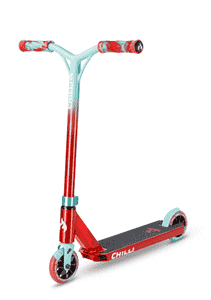
- New
Chilli Pro Scooter Jumpstart S - Red/Teal Eye-catching design in bright complementary colors- Jumpstart your freestyle journey in bright colors
- Boxed Profile Deck with the perfect width in 11.5 or 12.5 cm
- 110 mm Wheels with ABEC 9 Bearings for extra Speed
CHF 169.90 -
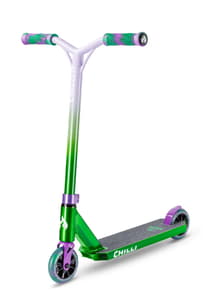
- New
Chilli Pro Scooter Jumpstart - S - Green/Purple Eye-catching design in bright complementary colors- Jumpstart your freestyle journey in bright colors
- Boxed Profile Deck with the perfect width in 11.5 or 12.5 cm
- 110 mm Wheels with ABEC 9 Bearings for extra Speed
CHF 169.90 -
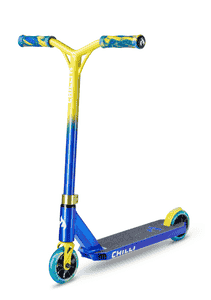
- New
Chilli Pro Scooter Jumpstart - S - Blue/Yellow Eye-catching design in bright complementary colors- Jumpstart your freestyle journey in bright colors
- Boxed Profile Deck with the perfect width in 11.5 or 12.5 cm
- 110 mm Wheels with ABEC 9 Bearings for extra Speed
CHF 169.90